WE EXPLORE STANDARD APPAREL HANGERS
UPDATED 27th JUNE 2026
Carly O'Connor
Carly is an experienced interior designer and Visual Merchandising Manager with 15 years in fashion retail. Her reviews focus on how products perform in real stores, looking at visual impact, practicality and whether they genuinely improve the shopping experience.
Apparel hangers look simple until you start paying attention. Then they suddenly become one of those small retail details that quietly affects everything.
A hanger is not just there to stop a shirt falling on the floor. It affects how the garment hangs, how the rail feels, how premium the brand looks and whether the product still looks fresh after a busy day in store. The wrong hanger can leave shoulder dents, stretch delicate fabrics, let garments slip, or make an otherwise lovely range feel a little bit cheap.
Most major fashion chains use bespoke hanger programmes. Their hangers are often designed around brand colour, garment type, supplier packing, size markers, reuse systems and store operations. At that level, the hanger is part of the retail machine.
But independents, boutiques, pop-ups, showrooms, small chains and charity retailers need something different. They need hangers that can be bought by the box, used straight away and still make the clothing look properly presented.
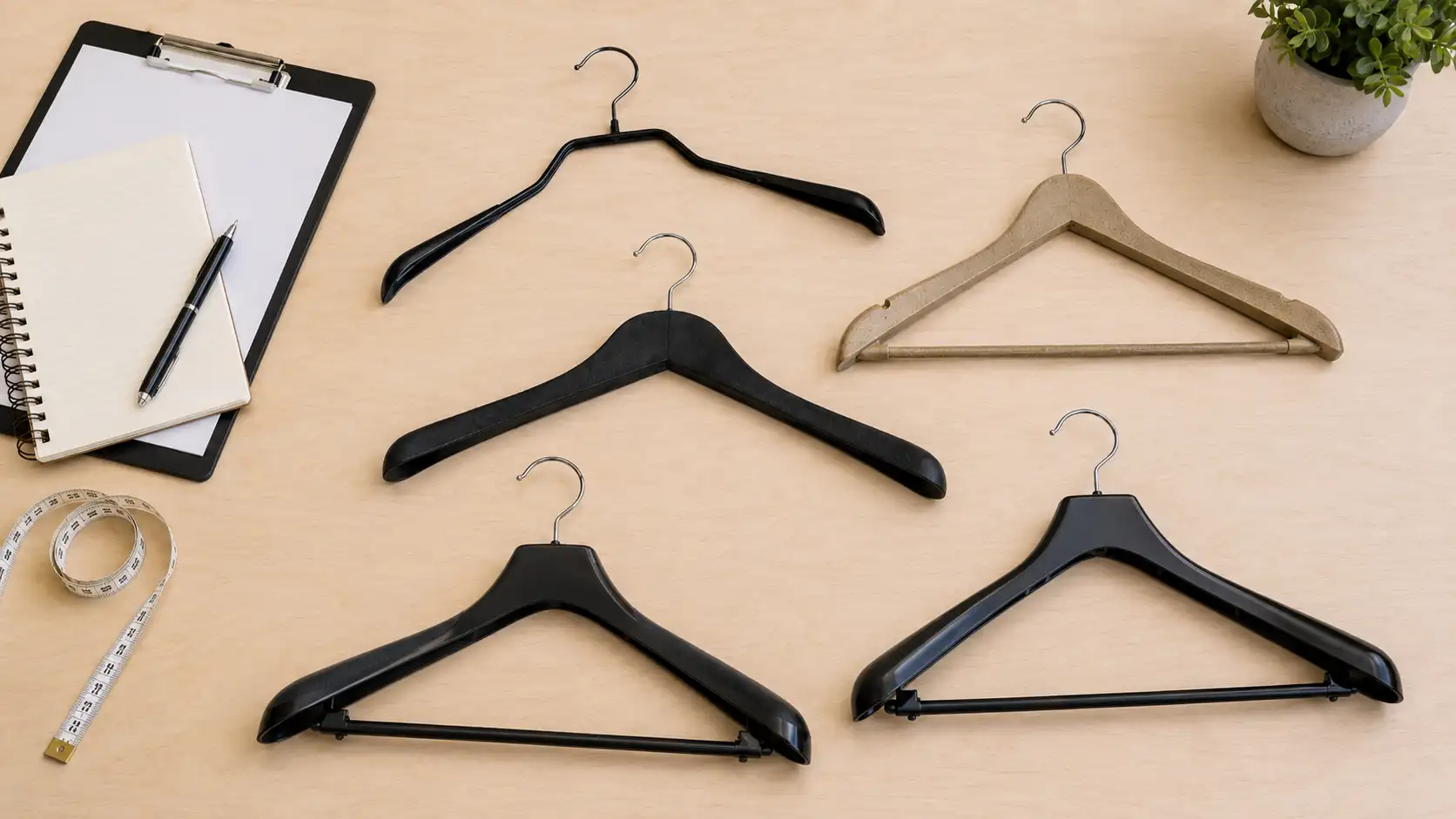
For this review, we looked at real off-the-shelf retail hangers from several UK suppliers. We considered shoulder support, garment protection, price, eco credentials, branding options, range depth, rail density, stock availability and whether the hanger actually suits the job it is being asked to do.
Some are better for garment support. Some help the brand story. Some feel more boutique. Some are built for volume. And some are there to stop slippery dresses performing a slow-motion escape onto the shop floor.
Read our reviews below to find out more.
Our Recommendations
★ Top Pick
Supportive
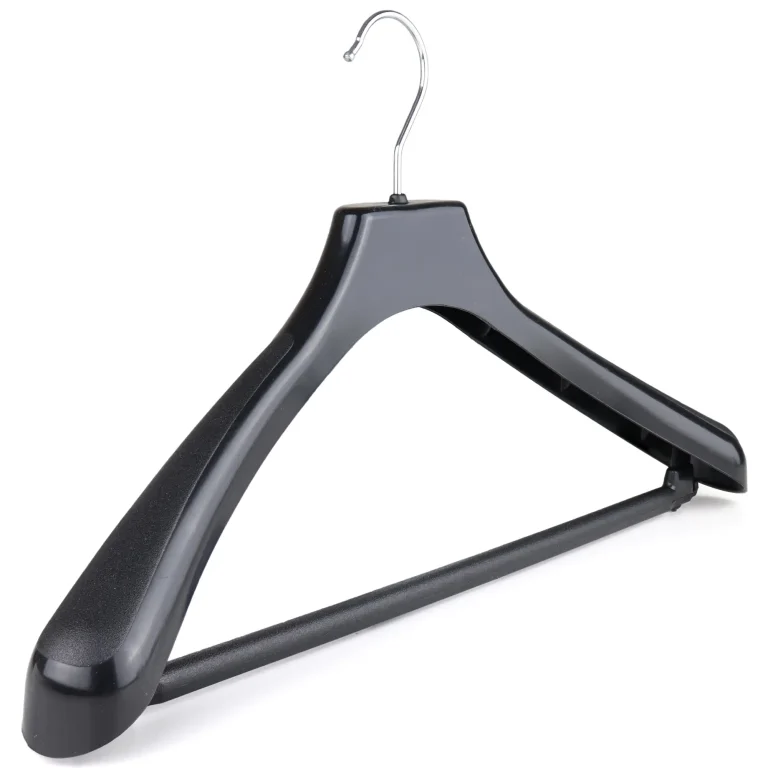
Black Plastic Suit Hanger – 42cm
This is our top pick because it gets the most important off-the-shelf job right. The broad 3.8cm shoulders help protect garment shape, while the trouser bar and underhooks make it useful across jackets, shirts, trousers, skirts and outfit displays. It can also be logo printed, which matters for independents and small chains wanting a more branded look.
Runner Up
Responsible
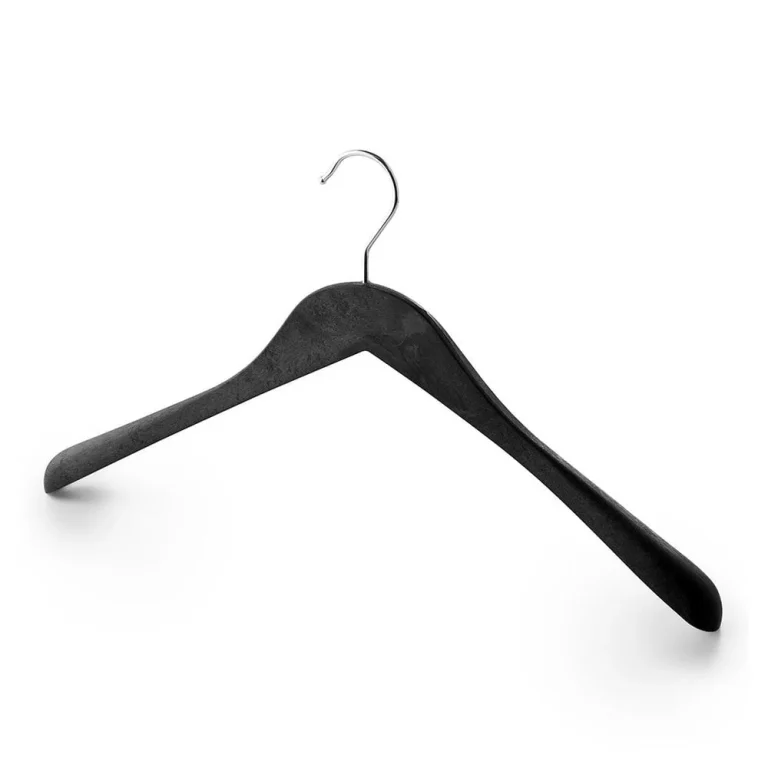
Matt Black Eco Plastic Hanger
This eco plastic hanger is a strong runner-up because it combines wider shoulders with recycled material. It is made from 90% recycled plastic and gives a better support story than most basic slim hangers. It lacks the trouser bar and branding options of our winner, but for a cleaner, greener off-the-shelf rail, it is very appealing.
Worth a look
Eco Friendly
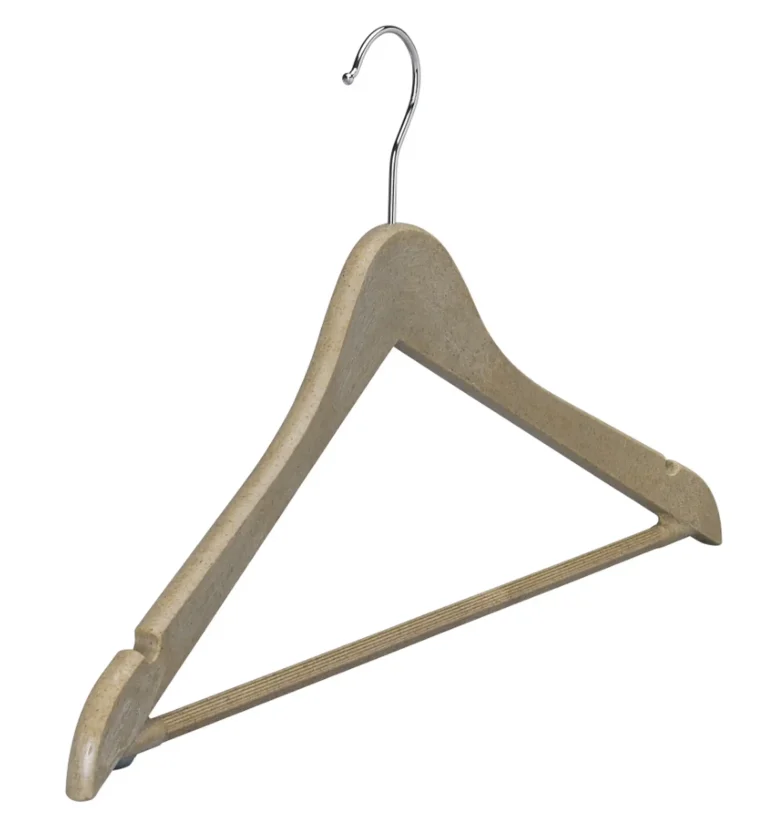
Recycled Ocean Plastic Clothes Hanger
This recycled ocean plastic hanger gives smaller retailers a more visible material story. It has a wishbone shape, bar, and logo print option, so it feels more considered than a plain economy hanger. It is not as shoulder-supportive as the winner, but it is a stronger brand and eco choice.
Basic
Value
Black Suit Plastic Hanger
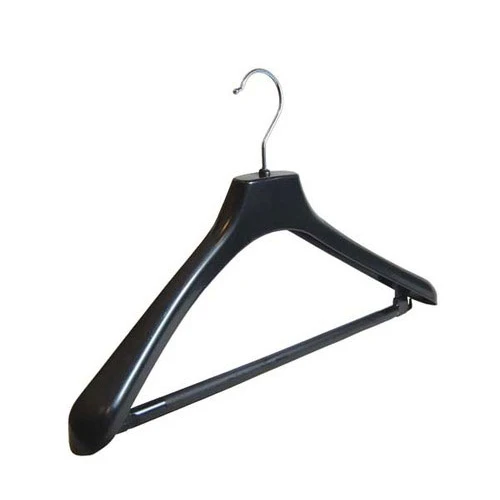
This is the practical value contender. It is a strong black plastic hanger with a broad shoulder profile, centre bar and chrome hook, sold individually at a low unit price. It does not have the same branding or range story as the winner, but for basic retail presentation, it is a solid commercial option.
Some merit
Non-slip
Non-Slip Jacket Hanger
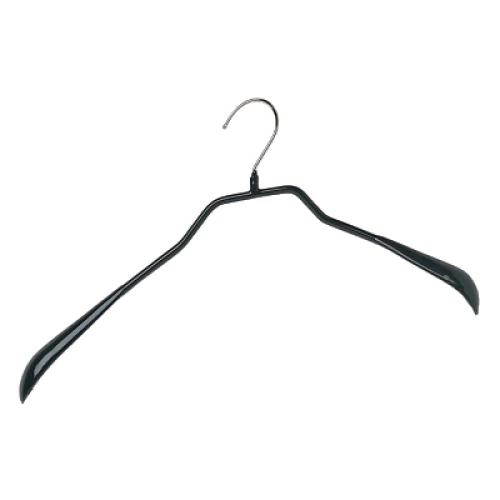
This non-slip jacket hanger is the specialist support-and-grip option. The broad jacket shape, black rubber coating and chrome hook make it useful for knitwear, jackets and garments that tend to slide. It costs more, but it solves a real problem on rails that staff are forever tidying.
*Prices as advertised on resellers websites, based on a minimum quantity of 500 units.
In Depth Review - Black Plastic Suit Hanger
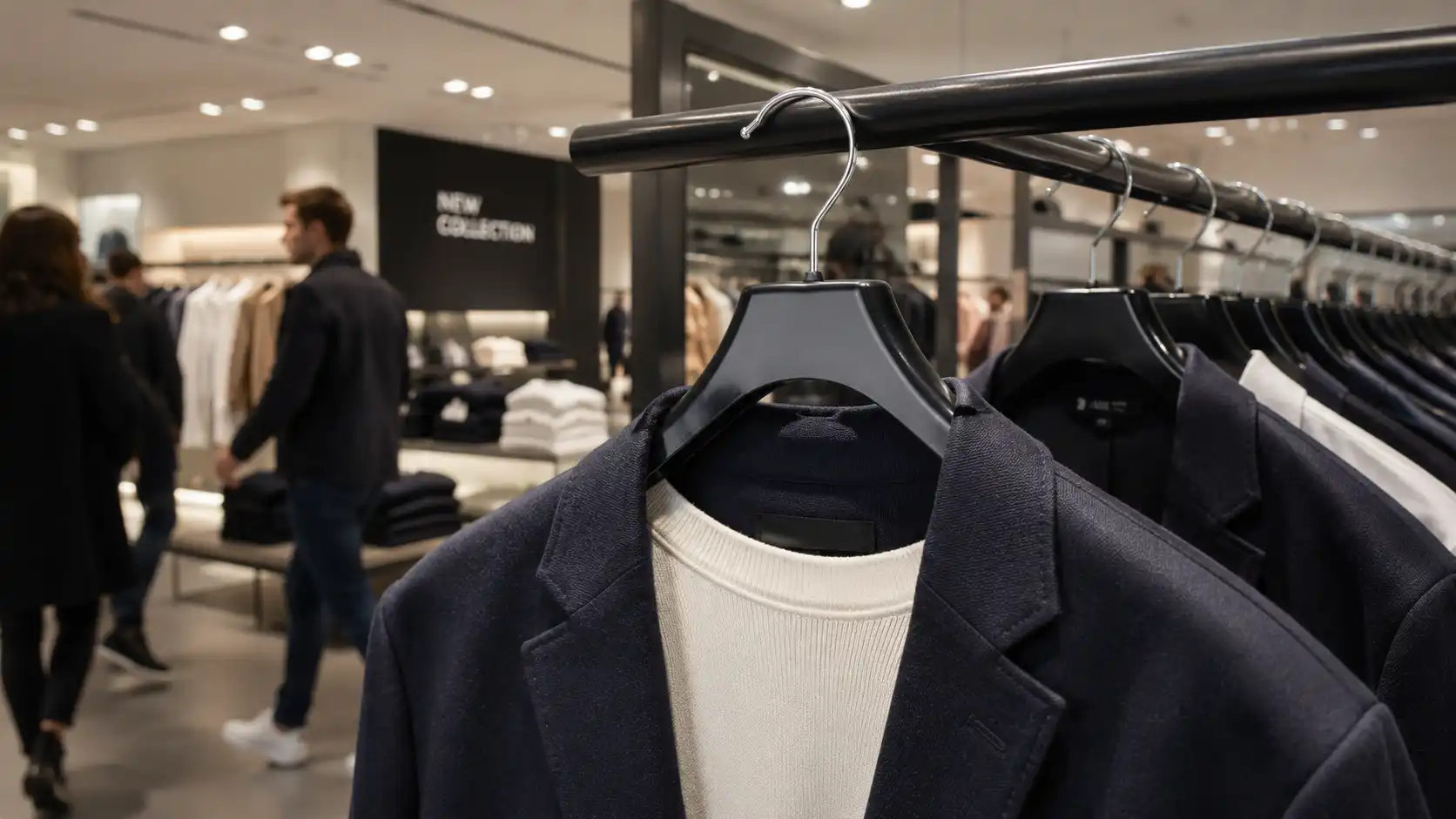
The Black Plastic Suit Hanger, for all Adult Suits & Jackets – 42cm won our off-the-shelf apparel hanger review because it does the most important retail job well.
It protects the garment better than a thin flat hanger, but it does not become so chunky that the rail loses too much capacity. It has a trouser bar, underhooks and broad shoulders, so it can work across a wider range of garments than most basic hangers. And, importantly for independents and small chains, it can be branded with a logo.
That combination is what pushed it into first place.
Why it won
A good off-the-shelf hanger needs to do more than look tidy in a product photo.
It has to support the garment, suit the rail, feel right for the brand, arrive in sensible quantities, and still make financial sense. It also needs to be repeatable. If a retailer buys more stock in six months, the hanger range needs to still exist.
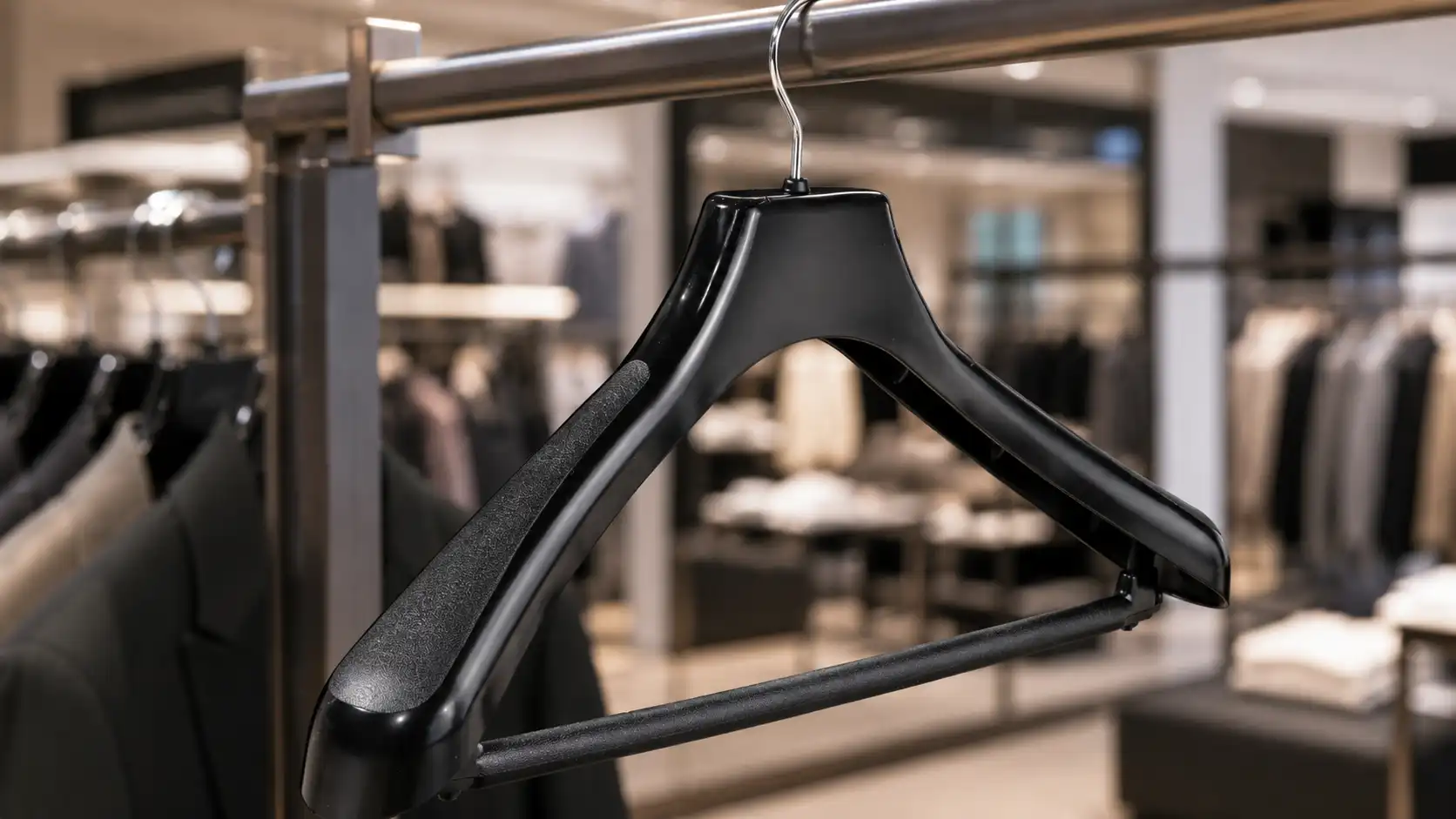
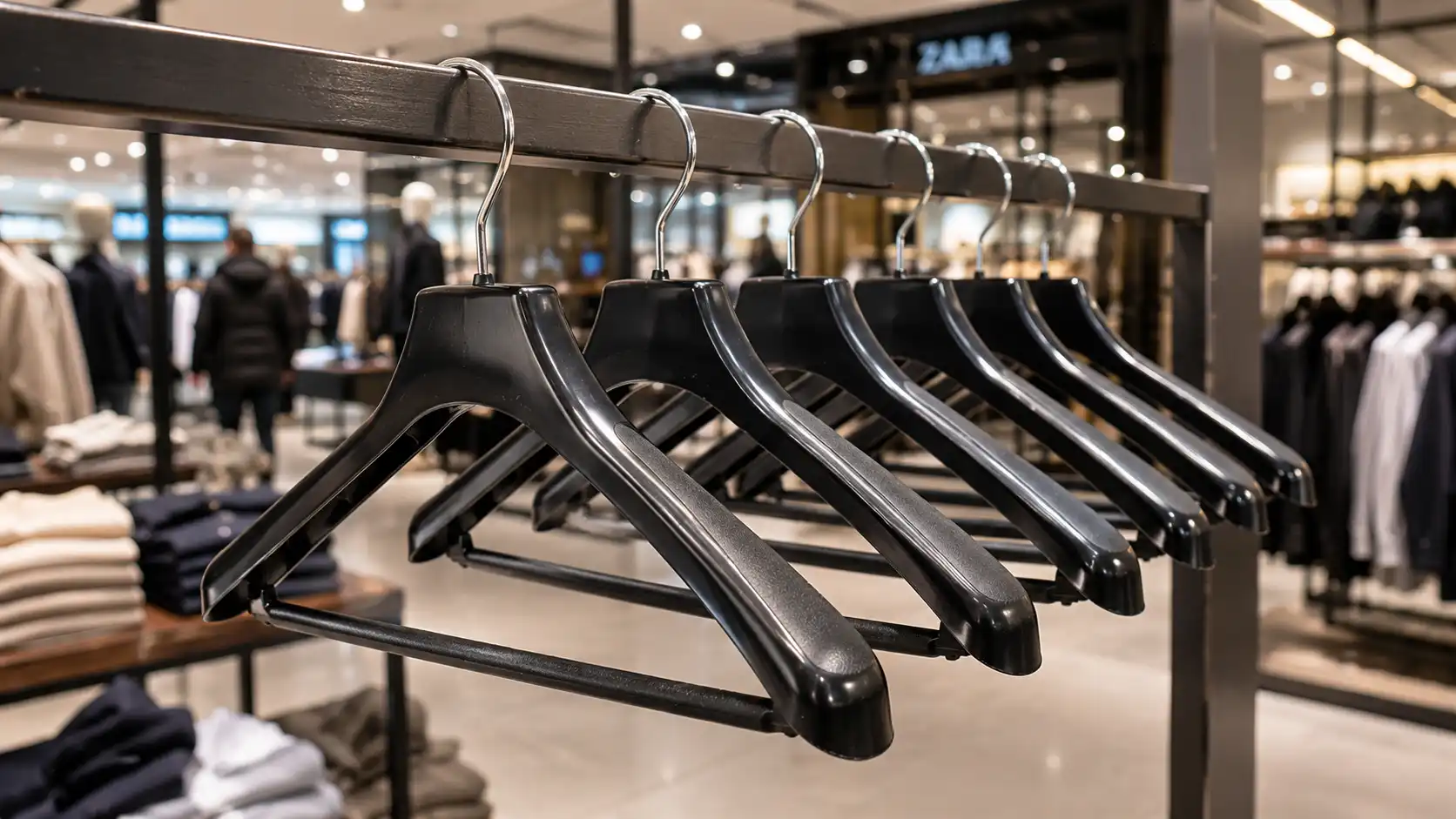
The 42cm black plastic suit hanger scores well because it is a proper working retail hanger. The shoulders are broad enough to reduce those sad little pressure points that can appear on shirts, jackets and soft garments. The trouser bar makes it useful for outfits. The underhooks help with skirts and garments with loops. The black finish works across most store interiors.
It is not the most glamorous hanger in the world, but that is almost the point. It lets the garment do the talking.
Better support, fewer sad shoulders
Shoulder dents are one of those small display problems that make clothing look older than it is.
A narrow hanger can push into soft garments, create points, stretch fabric or make a new product look as if it has already had a difficult life. A broader shoulder spreads the load better and helps the garment sit more naturally.
That is where this hanger feels right for independent fashion retail. It offers more structure than an economy shirt hanger but is still compact enough for normal commercial rails. For shirts, overshirts, casual jackets, lightweight coats and better everyday apparel, it gives a very useful level of support.
Brand feel
Black plastic can sound basic, but it can also look very clean when used consistently.
A whole rail of matching black hangers gives the product a tidy, modern frame. It works with monochrome interiors, industrial displays, charity retail trying to lift mixed stock, market traders wanting a more professional look, and small brands that need a simple hanger that does not shout over the clothing.
The other important point is branding. Independents often think branded hangers are only for large chains, but some standard hanger suppliers offer logo printing. That allows a small retailer to add a more professional touch without paying for a fully bespoke hanger programme.
Shop-floor practicality
This hanger feels realistic for the audience we are reviewing for.
It is available in different pack sizes, it is not frighteningly expensive, and it sits within a broader hanger range. That matters. A shop may start with jacket hangers and later need trouser hangers, skirt hangers, childrenswear hangers or wooden versions for a premium range.
One-off novelty hangers can look interesting, but range continuity is often more useful. Retailers need to keep the shop looking consistent as stock changes.
Overall verdict
The 42cm Black Plastic Suit Hanger won because it is the best all-round off-the-shelf answer.
It gives good garment support, useful outfit flexibility, sensible cost, branding potential and a clean commercial look. It is suitable for independents, pop-ups, showrooms, small chains, charity retailers and anyone wanting a proper retail hanger without going bespoke.
It may not make anyone gasp with excitement. But it will stop your jackets looking like they have given up.
And that is a very good start.
The Rail-Arm Sign Holder Test
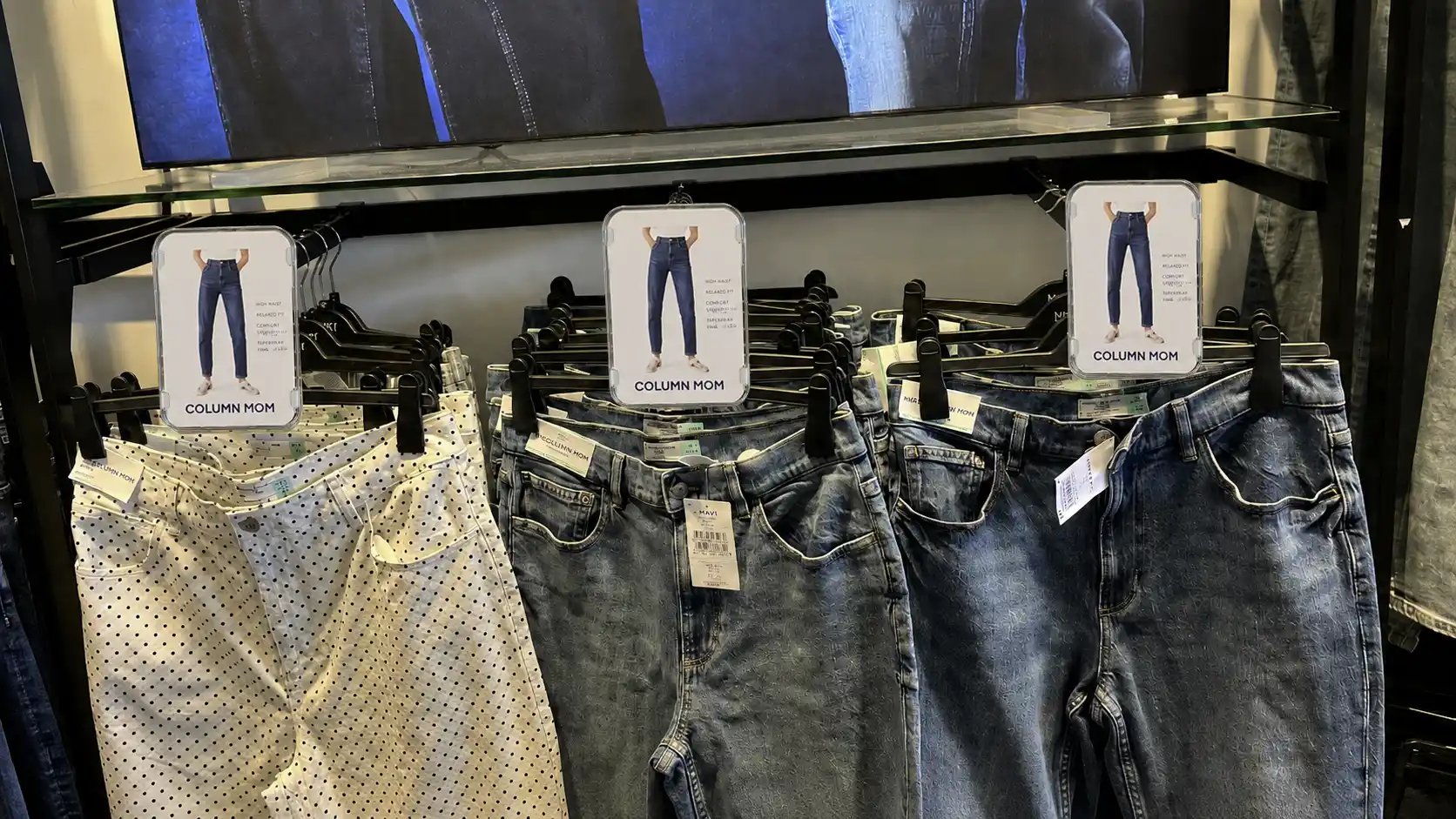
For this review, we looked at five different products all trying to win the same valuable bit of retail space: the rail-arm sign point.
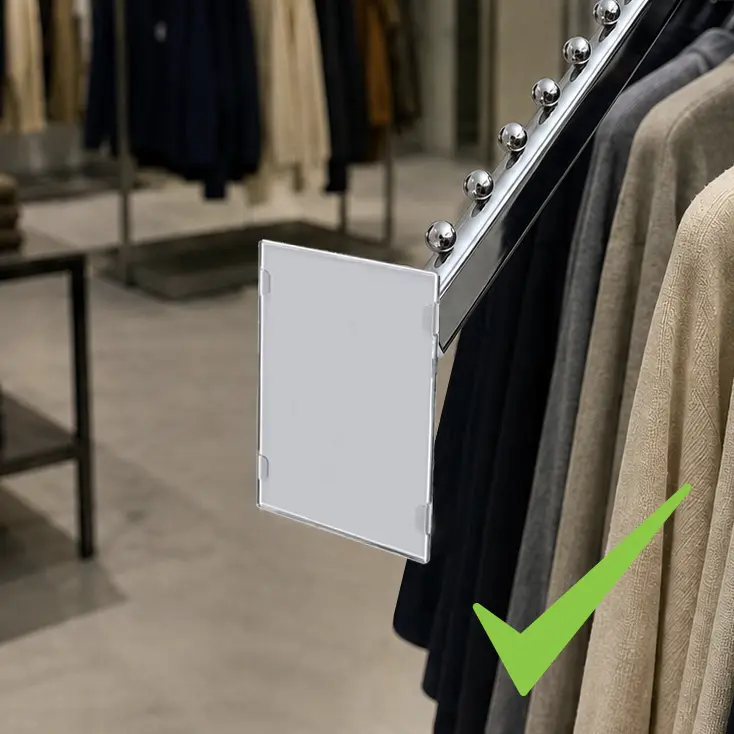
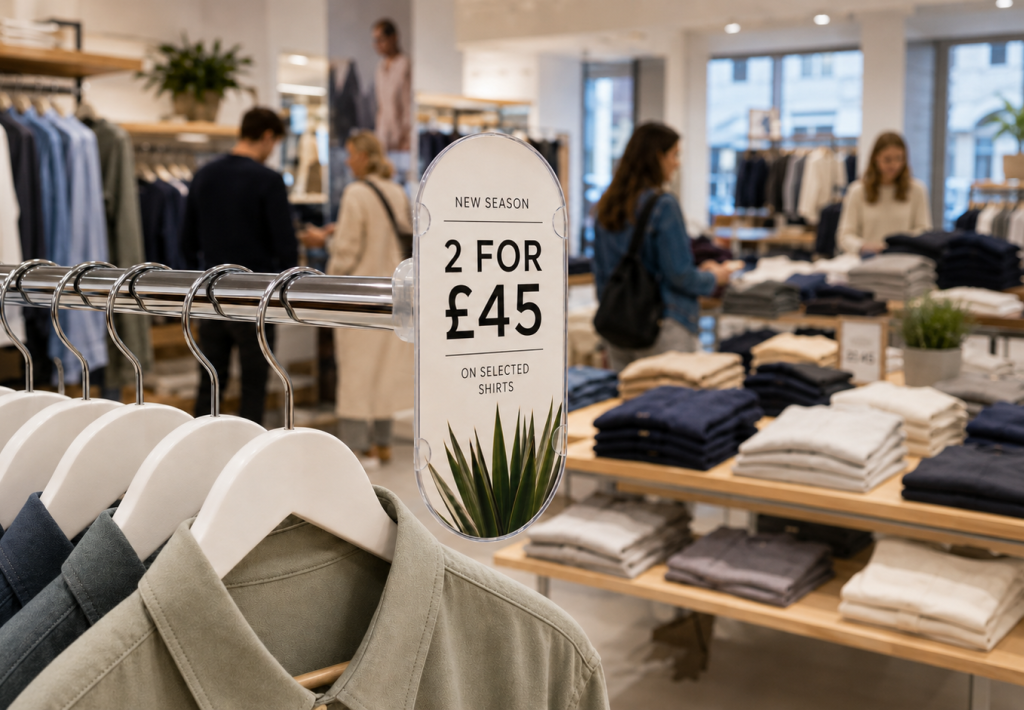
It may not sound glamorous, but this is prime retail real estate. It is right next to the product, right in front of the customer and perfectly placed for prices, promotions, offers and product benefits. If a retailer wants to say “New”, “Sale”, “Two for £20” or “Made from recycled materials”, this is exactly where that message needs to be.
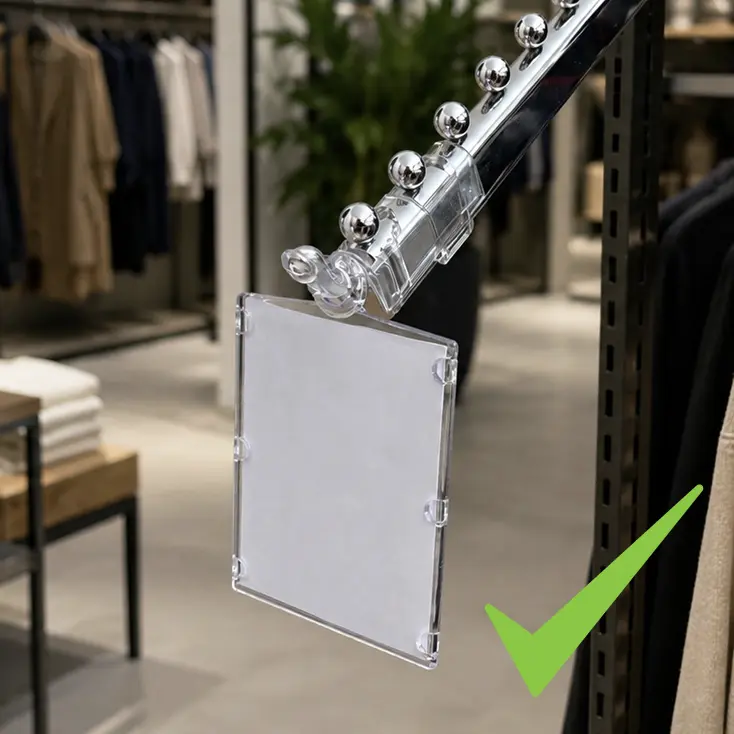
Graphics can do a lot of the hard work. A strong printed insert can help a retailer create its own look and feel. But the holder itself still matters. Too many older rail-arm sign holders look very similar, whether they are used in a budget store or a premium fashion environment. That is one of the areas where we think the TagTalker graphic holder has a clear edge, with a broader choice of shapes, formats and more distinctive presentation styles.
The other four contenders:
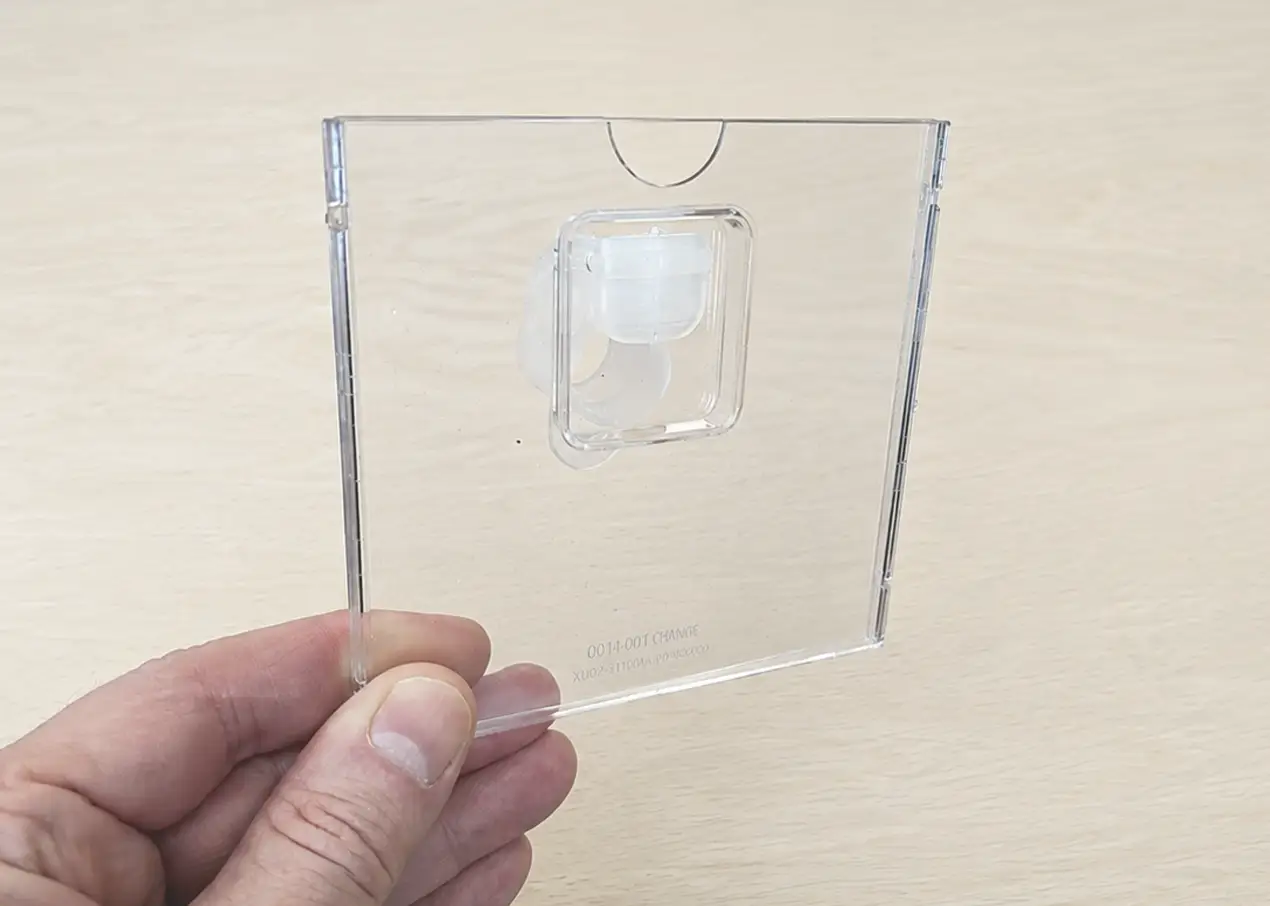
Runner-up: Reflex Graphic Holder
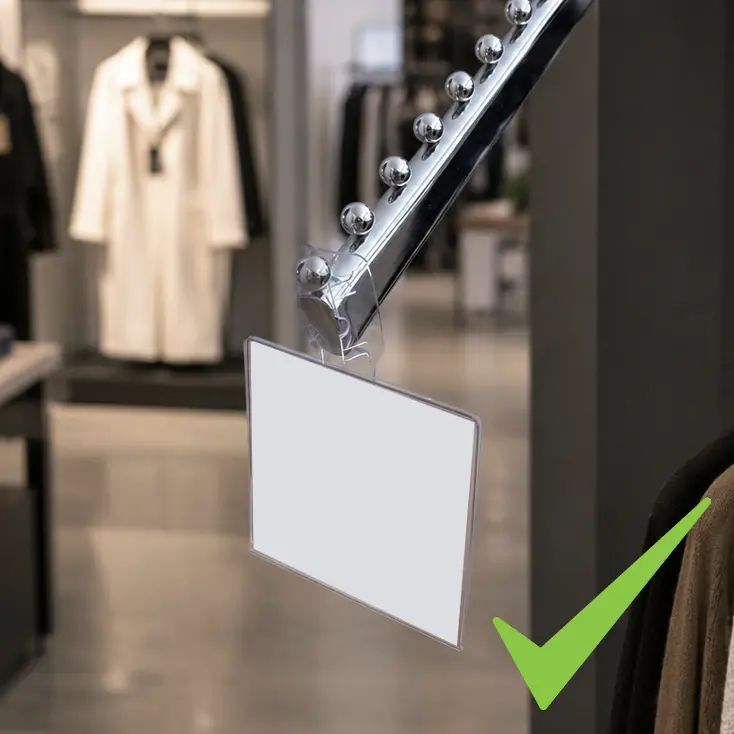
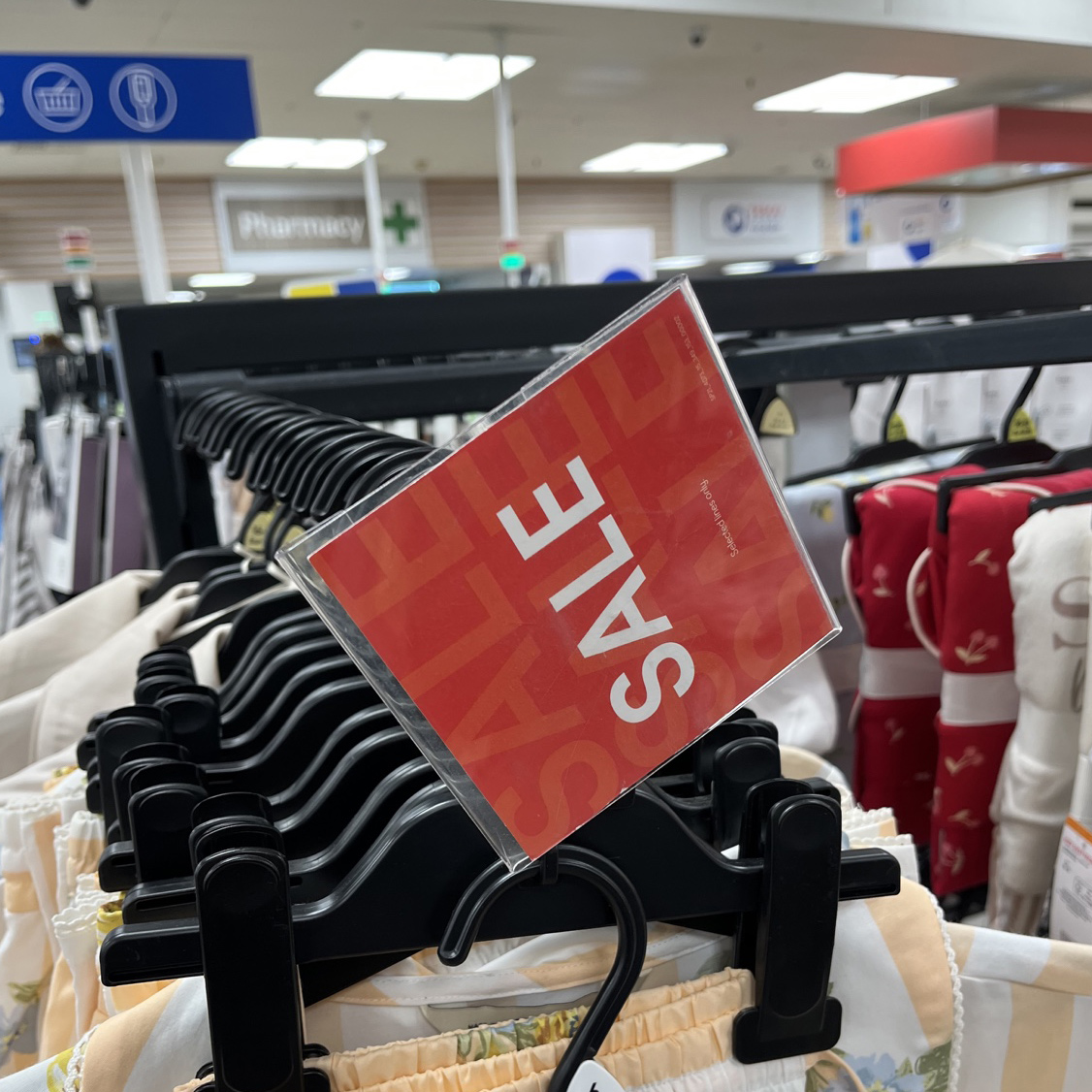
The Reflex graphic holder has been around since around 2009 and is a familiar product in the retail display market. It uses a flexible backing with a simple cassette-style sign holder, and bespoke fabricated PETg shapes are also available.
There is a reason this type of product has been popular. The flexible backing allows the holder to move out of the way when customers are shopping from the rail, which is exactly what you want in a busy store. When fitted properly, Reflex holders can look smart, especially in supermarkets, value retailers and high-volume environments where function matters as much as appearance.
The issue we saw was not always the product itself, but how it looked once it had been fitted in real stores. During our store checks, some Reflex-style holders were sitting at different angles, leaning downwards or pointing slightly out of the natural customer eyeline. Once knocked, some did not always return neatly to a tidy upright position.
That is the danger with any flexible sign system. It may leave the factory looking perfectly neat, but the real test is what it looks like after staff, customers, hangers, coats, bags and busy Saturday shopping have all had their say.
In the right setting, Reflex can still do a good job. But for retailers chasing a more premium or highly consistent visual standard, the occasional leaning or untidy presentation may be a drawback.
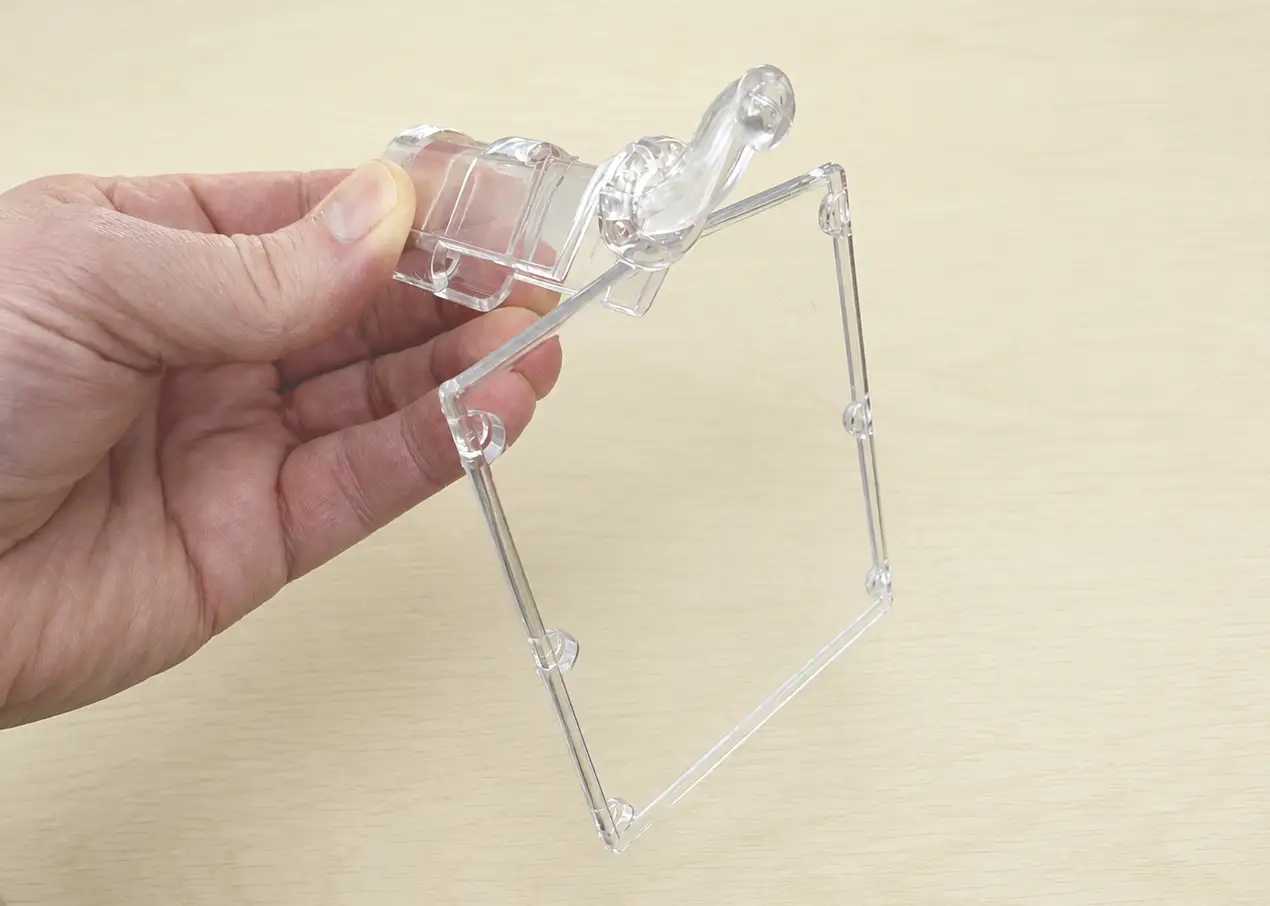
The Rigid Plastic Swan-Neck Holder – UK POS
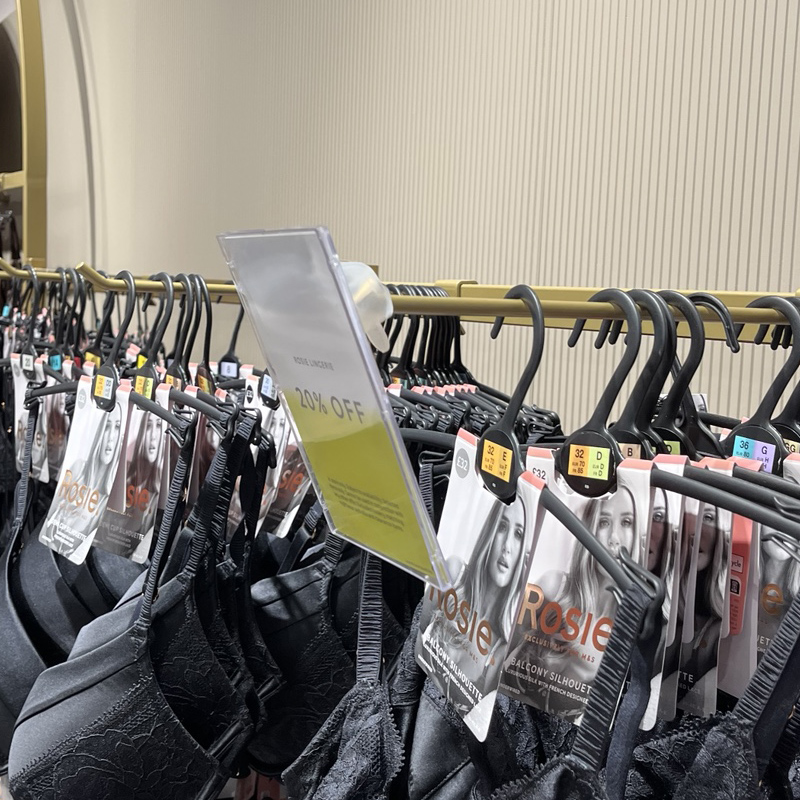
Our third entry is the rigid plastic Swan-neck graphic holder, sold through UK POS. This one is a little more unusual. It has a flexible tube-style rail-arm gripper with various cut-outs, combined with an extended neck. A single-sided transparent graphic holder then hooks onto the neck through a circular loop.
Once installed, the sign swings freely and self-levels in several directions. That is a definite plus. It should also work on cascade-style arms, which makes it more adaptable than some more basic holders. So far, so good.
The concern is fit. In our view, it appears best suited to certain rail-arm sizes and shapes, particularly standard oval tube arms. We think it may struggle with deeper rectangular tube arms or some circular tube arms. Not all rail arms are the same, and that is where this type of design can become more limited.
The gripper also has relatively limited flex, which raised some questions for us about long-term durability in a busy store. Because the graphic holder can rotate freely, there is also a possibility that it could twist around or become caught up on the rail arm during use.
It is a clever idea, and the self-levelling movement is useful. But once we considered compatibility, durability and day-to-day store use, it did not score as highly in our review.
The Flexible Sign Holder – UK POS
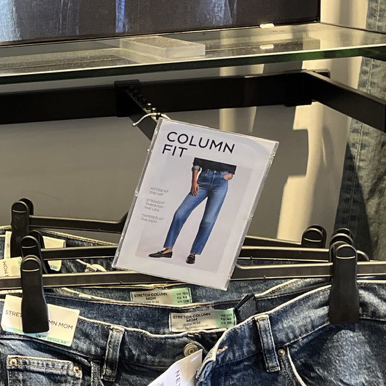
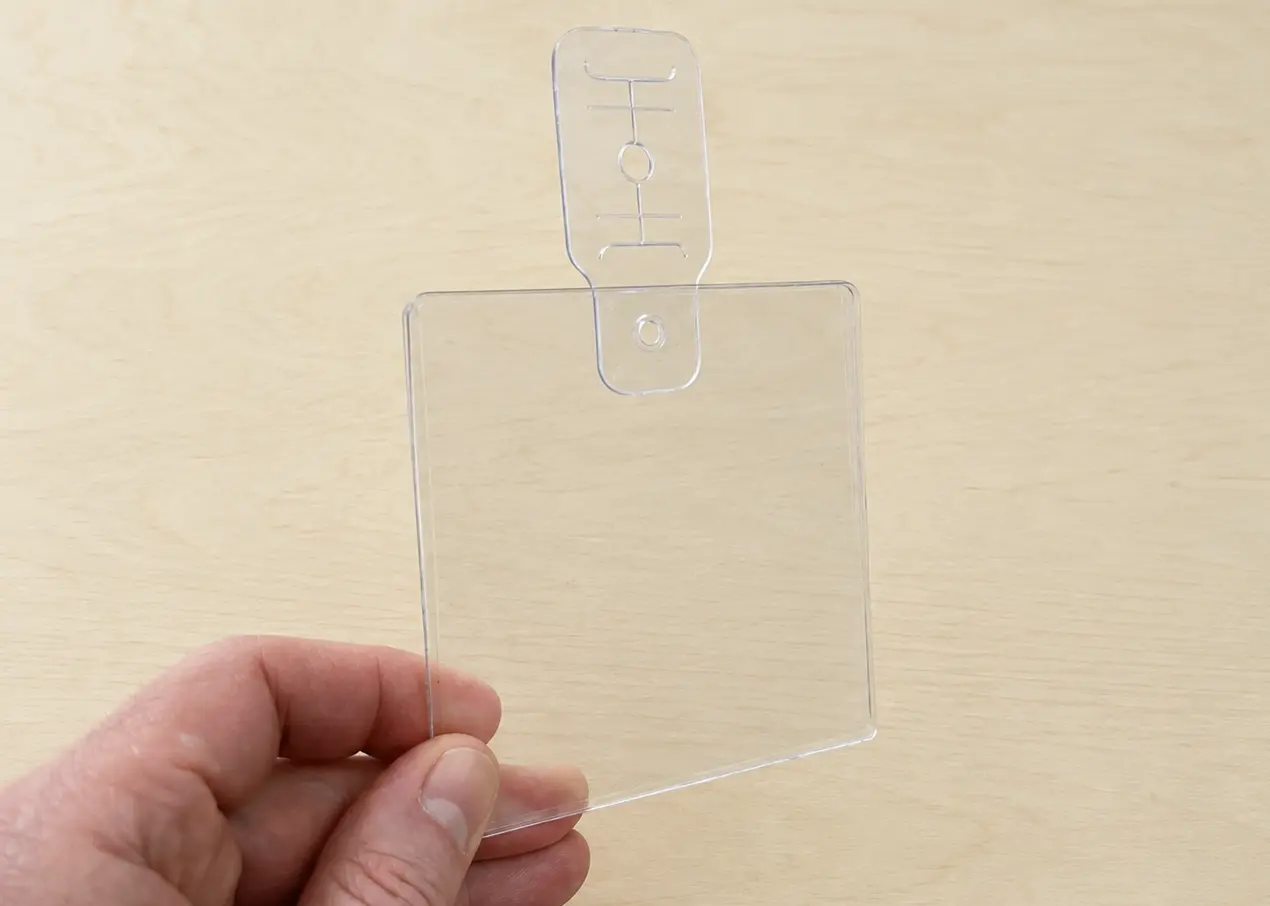
Our fourth entry is the Flexible Sign Holder from UK POS. We liked its simplicity. It is a fabricated PETg sign holder connected by a nylon-type plastic rivet to a PVC die-cut tab. The tab has a series of slots, allowing it to slide over different tube arms and wire arms.
It is not trying to be clever for the sake of it, and that is part of its appeal. In use, the holder can flex out of the way if knocked, while the rivet allows the sign face to move freely and stay reasonably level. For volume use, especially where price is a major factor, it looks like a practical option for budget retailers.
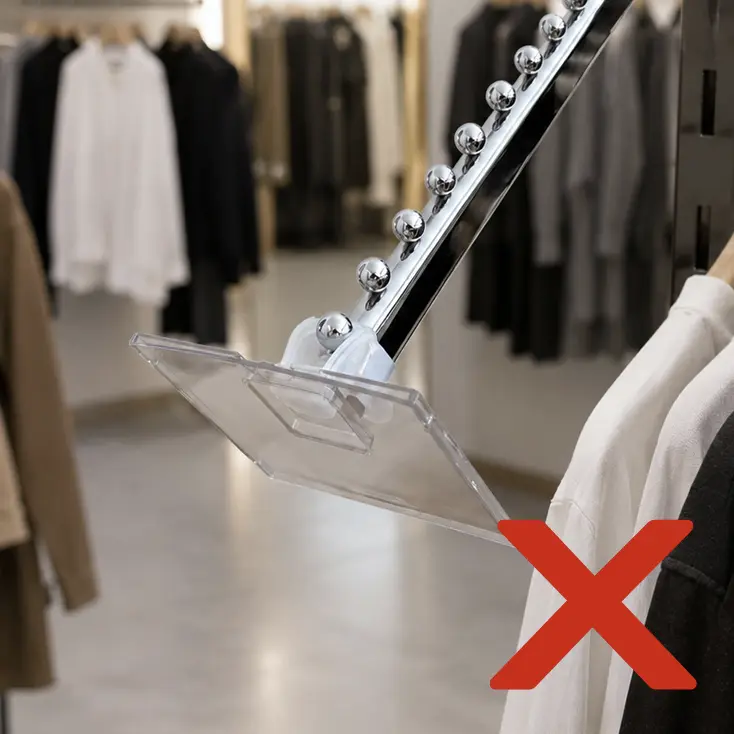
The trade-off is presentation. We found that it sits quite low on the rail arm, which can start to cover the very product it is there to promote. It can also slide along the arm during use and may be knocked off more easily than more secure systems.
So, as a low-cost, high-volume option, it has plenty going for it. But for retailers wanting a more premium, controlled and consistent look across store fixtures, it feels a little more functional than polished.
Metal Rail-Arm Graphic Holders
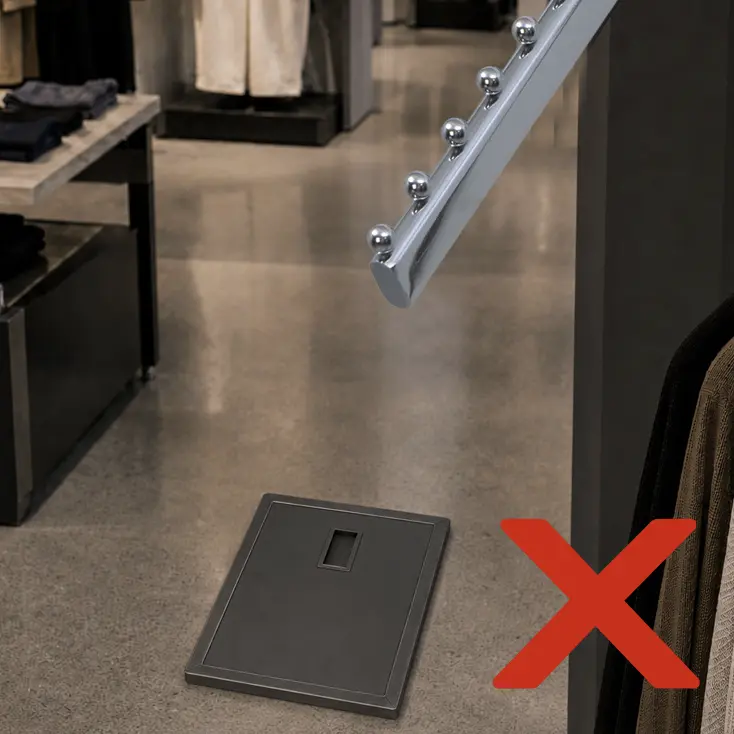
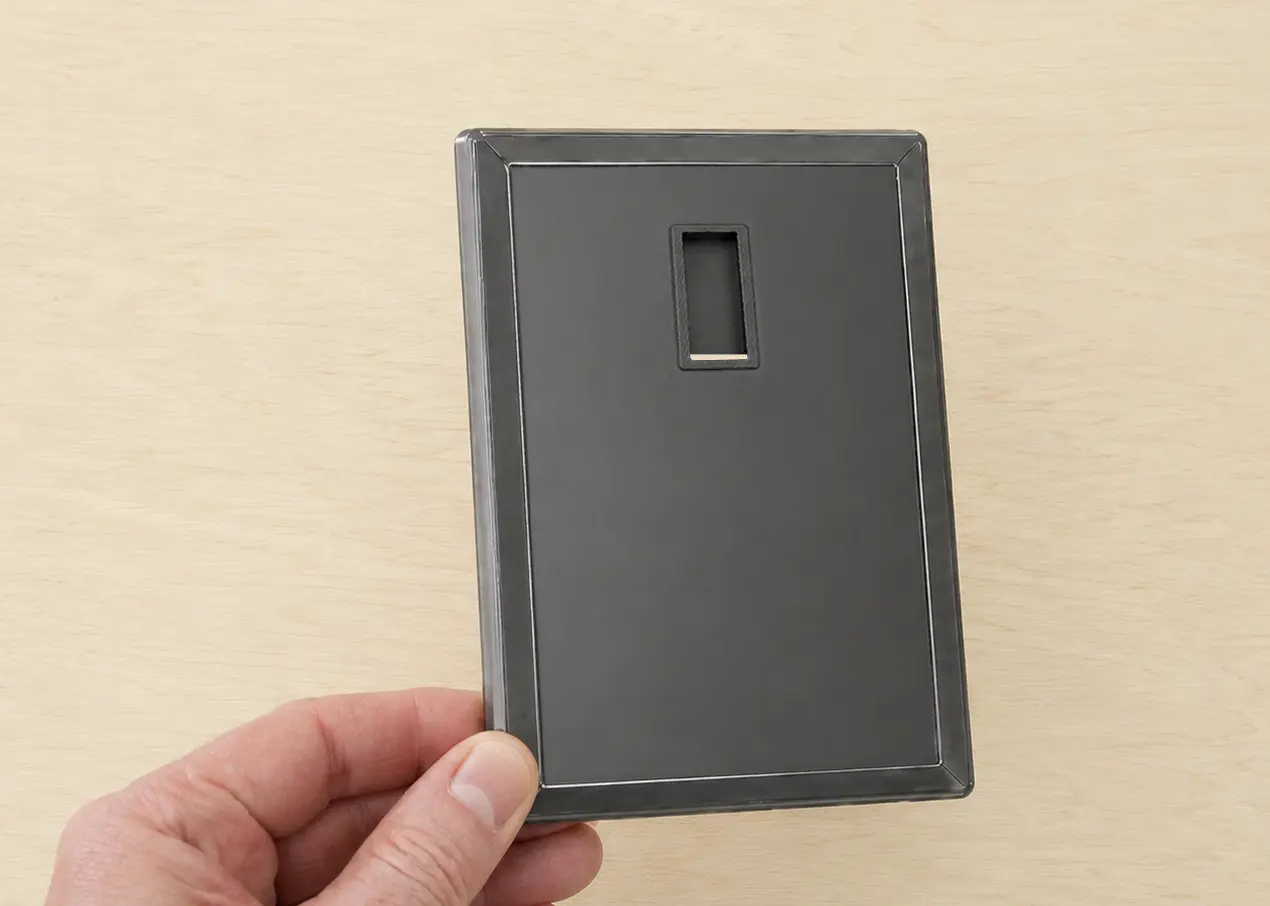
Finally, we looked at some more traditional bespoke metal rail-arm graphic holders. These usually have a simple U-shaped metal frame with a small recessed pocket on the back, allowing the holder to slide over tab-end rail arms.
There is something quite smart about them in the right environment. They stand upright, feel solid and can give a fixture a neat, structured appearance. They also have that slightly industrial, warehouse-style look, which may suit some retail interiors.
But they are not exactly subtle. They can look a little chunky, and their biggest limitation is compatibility. These holders generally only work with tab-end rail arms. That may be fine for one store, one fixture type or one carefully controlled display, but it becomes a problem for a retailer with mixed rail arms across a national estate.
In use, the weight and rigidity also work against them. They have no flexible movement, so getting hangers off the arm can become more awkward. The harder corners and rigid construction also feel less forgiving in a busy retail environment, especially compared with lightweight plastic or flexible systems.
There is another practical issue too. If knocked upwards, the holder could potentially lift off the rail arm. Nobody wants a metal sign holder taking a surprise trip to the shop floor.
For those reasons, we marked the metal holders lower in our overall assessment. They can look smart in the right place, but for retailers needing a lightweight, adaptable, safer-feeling and easier-to-manage solution across different store formats, they feel more limited.
Do they work with cascade fixtures
Choosing the right sign holder for your store
The end of a rail arm is a great place to put a message. It is exactly where the customer is browsing, lifting hangers, checking colours, looking at sizes and deciding whether the garment is worth taking any further. So putting price, promotion or product information here is a very good idea.
During testing, it quickly became obvious that the holder which informs the customer, while still allowing them to shop unhindered, wins every time.
We tried the holders on different rail arms, including cascade arms, and the differences were more obvious than expected. Some sat neatly and did their job well. Others were less successful, leaning away from the customer, twisting out of level, or ending up at an angle that made the graphic harder to read. A sign at the end of a rail arm works best when the customer can read it easily.
This is where self-levelling starts to feel less like a clever feature and more like a practical shop-floor advantage. When a holder was knocked, brushed by clothing or nudged by a hanger, the better designs moved out of the way and then settled back into a readable position. That makes the message easier to maintain without staff having to keep straightening things by hand.
The other thing we noticed was how customers do not gently operate a clothes rail. They pull hangers forward, lift garments off, push them back again and often do it one-handed. With more rigid holders, especially fixed metal ones, returning a hanger could become awkward. In some positions, the back of your hand can catch the holder as you try to put the hanger back on the rail.
That might sound like a small thing, but on a busy shop floor it matters. If a fixture is easy to use, shoppers are more likely to put garments back properly. If it feels awkward, hangers can end up draped over the top, pushed back badly, or left for staff to sort out later. So the sign holder is not just displaying the message; it is also part of how smoothly the fixture works.
The right sign holder, then, is not just the one that looks smart when fitted. It has to stay readable, suit the rail arm it is fitted to, cope with normal customer handling, and stay out of the way while people shop. In our testing, those small details made a very noticeable difference.
Comparison grid
Copycats, Lookalikes and the Hidden Risks
Retail display products may not be as glamorous as trainers, handbags or vacuum cleaners, but they still get copied. In fact, if a product is simple, useful and sells in volume, someone somewhere will usually try to make a cheaper version of it.
A lookalike sign holder, hanger or rail-arm display fitting can seem like a bargain at first glance. It does the same sort of job, looks roughly similar and comes in at a lower price. The problem is that cheap copies can sometimes come with a hidden cost.
Intellectual property rights are territorial. That means a product might be manufactured overseas in a country where a particular patent, registered design or other right is not in force. But if that same product is then imported, stocked, supplied or used in a country where those rights are protected, the issue can quickly move from “cheap alternative” to “legal headache”.
For retailers, this is the part that really matters. A buyer may think they are simply saving money on a display accessory, only to find later that the product may copy a protected design or patented feature. By that stage the goods may already be in store, fitted to fixtures, supporting a promotion and sitting in front of customers.
That is when the bargain starts to look rather less clever.
We have seen rail-arm graphic holders, sign holders and hangers in the market that appear very close to established products. Sometimes the differences are obvious. Sometimes they are not. Either way, retailers should be careful, especially when buying large volumes from unknown or overseas suppliers.
Our advice is simple: before placing a volume order, make sure the supplier has the legal right to sell the product in your market. Ask whether the product is genuine, authorised, licensed or independently designed. Ask for written confirmation that it does not infringe third-party patents, registered designs or trade marks. And ask who carries the risk if a claim is made later.
Because with display products, as with most things, the cheapest option is not always the safest one.
A genuine, properly authorised product protects more than the fixture. It protects the store roll-out, the brand, the supply chain and the people who have to deal with the problem if something goes wrong.
Our conclusion
Our test winner is the TagTalker graphic holder.
New for 2026, TagTalker feels like a genuine step forward for the rail-arm graphic holder category. It is not just another clear plastic pocket hanging from a fixture. It has clearly been designed around the real problems retailers deal with every day: signs being knocked, holders sitting at odd angles, graphics looking untidy, staff fitting products quickly, and fixtures needing to work across different store formats.
The self-levelling mechanism was the standout feature in our test. It allows the holder to move when pushed or knocked, then return neatly to an upright position without swinging around endlessly or looking untidy. That sounds simple, but in a busy store it makes a big difference.
We were also impressed by how robust and easy to use the product felt. Fitting it to the rail arm was straightforward, changing the paper graphic was simple, and the wider range of shapes gives retailers far more creative freedom than the usual square-and-rectangle options.
There are cheaper products available, and some of them do a decent job in the right setting. But as an overall package — presentation, movement, compatibility, usability, brand impact and store-readiness — TagTalker came out clearly ahead.
So, after testing the options, knocking them about, fitting them, refitting them and looking at how they would actually behave in store, it really is time for that cup of tea.
Meet your reviewer
Seff Bakerman
Seff Bakerman is a seasoned retail designer, visual merchandising manager and writer with a habit of putting display kit through its paces. He reviews products from both sides of the rail: how they help the customer shop and how they work for the retailer on a busy shop floor. Originally trained in furniture design, Seff has worked with major fashion retailers and leading supermarkets in the UK and US, managing visual merchandising projects, display fixtures and store roll-outs.